What Are the Two Major Classifications for Fiber Art? Explain
Fiber art can be considered as both new and an old form of art. The use of fibrous materials and the appearance of the woven, knitted, printed, or in other ways treated materials has long appeared in our history. Traditionally, fibrous materials emerged equally functional objects but in the aftermath of the World War II and with further investigation into the nature of an art object, cobweb art slowly became a force in its own right. During the 1950's, as various artists-craftsmen received recognition, the term cobweb art was coined to help describe their work. During this menses, the contribution of craft artists , not just in fiber only in dirt, ceramics, and other media inspired a number of weavers to begin bounden fibers into non-functional and not-objective forms as works of fine art. Nonetheless, the two decades that followed, the 60s and the 70s brought an international revolution in fiber art. With the rise of the women'due south movement, and the consequences of feminist art, forth with the birth of postmodernism theory, fiber art was reinforced.
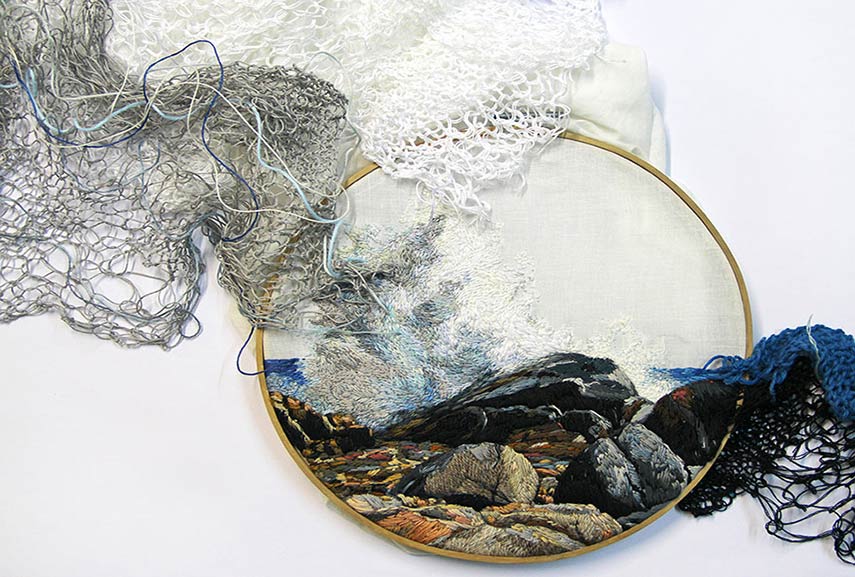
The History and the Basics of Fiber Art
Fiber fine art refers to fine art whose material consists of natural or synthetic fiber, and other components, such equally material or yarn. Placing focus on the materials and the manual labor on the role of the artist, artful value over utility is prioritized. Typically, fiber creatives use the method of weaving for the creation of their small or big pieces. Side by side to this technique, creatives are known to exercise the human activity of knotting, twining, plaiting, coiling, pleating, lashing, and interlacing.[1] Also known as fabric art, fiber art was introduced afterward the war to narrate original art developments in textiles and to help define works being done in fiber since the 1920's. The two writers Larsen and Constantine were, in fact, the creators of the term which they defined as generic and standing for all fibrous constructions.[2] The two authors also explained the methods and the agreement of the loom every bit an expressive tool which helped cobweb authors dispense with materials and to produce their objects and pieces. Building upon the meaning and tradition of weaving, modern fiber fine art needs to be defined through the history of cloth art and the arts and crafts motion as well.
The Language of the Textile Thread – Fiber Art every bit an Arts Movement
During the 1950's, every bit authors pushed for the fresh understanding and use of the fiber, diverse creators in Europe and America experimented with the cosmos of works which hung on the wall or were produced equally gratis-standing two or three-dimensional works. Fiber authors explored the quality of the textile or linear elements of linen, sisal, and cotton fiber in order to create nonobjective or figurative objects. Artist Lenore Tawney, a former student at the New Bauhaus affiliated with the original Bauhaus schoolhouse in Federal republic of germany, was, in fact, the first to create 3-dimensional pieces with the assistance of cobweb which entered into the loonshit ofsculpture and installation art. Her 1961 exhibition at the Staten Island Museum is defined as the event which launched cobweb art in the USA and which helped this grade of creativity to office from the thought of being a mere arts and crafts.[3]
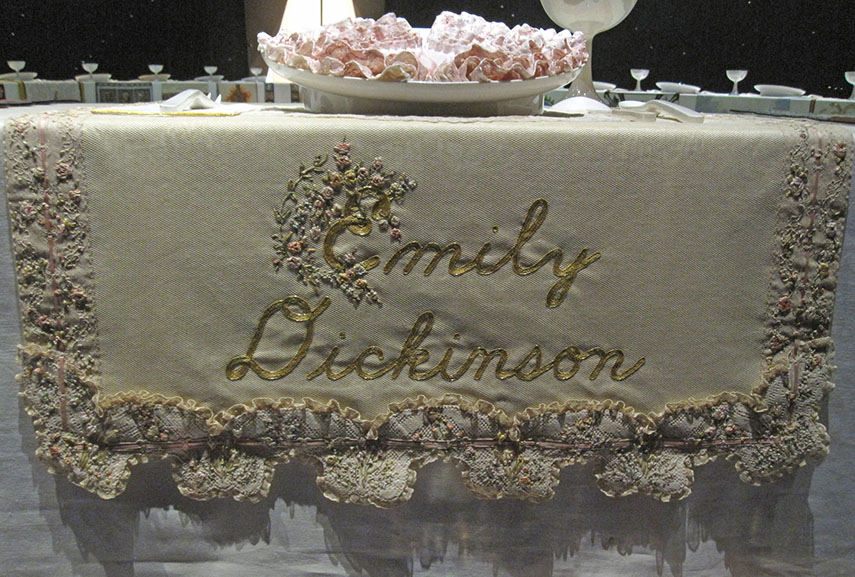
Yet, information technology was the feminist fine art motility and its dominant figure Judy Chicago that reintroduced textile and fiber into high art. Equally knitting, weaving, or needlework were typically considered as a woman'due south task of leisure or of skill, this was a major pace frontwards. Redefining the history of art subjects and themes, feminist artists used the medium to subvert its history equally 'women piece of work' and transform it into colorful, fun, and sexually liberated works. Judy Chicago and the group of creatives which she gathered for her projection Womanhouse all worked with fiber art. Chicago's piece The Dinner Party is, in fact, defined equally the beginning high fine art slice which incorporated and celebrated needlework and fabrics as role of women's history.[4]

What Fiber Art Managed to Create
Since the 1980's, various fiber works, influenced by the postmodernist theory accept become more and more conceptual. The theory inspired pieces which confronted cultural issues such equally gender , issues of politics and socially predetermined roles, identity , then on. Presently, diverse fiber authors are even so focused on redefining what is craft and what is art. Leaning on the tradition which saw tapestries moving abroad from the wall into the space of the gallery as a costless-standing abstract and oftentimes geometric object, many creatives explore how fiber and its smallest pieces could be the base of abstract sculpture.[5]
Within the eclectic character of contemporary art production, many fiber creatives dip into the sphere of wearable fine art creating extravagant pieces of both article of clothing and of various forms.[half-dozen] Moreover, in that location are numerous art events and festivals which are organized to promote cobweb art. The Fiberart International in 2016 divers its medium as "annihilation fabricated of flexible, linear material and/or constructed using textile techniques such as stitching, weaving, dyeing and embroidering". The show displayed that fiber art promotes and operates both in the form of its tradition and as a present object representing the digital and technological age.
From hand embroidery, tapestry and quilt production, to large-scale public art pieces or miniature handmade lace doily, fiber fine art is for sure a movement which continues to help define what is art product today.


This book is a documentation of the history of cobweb fine art which became popular in the 1960'southward. Where once the focus was on knotting, twining, and coiling thread into works that were immediately recognizable, and therefore connected to utilitarian crafts, fiber authors of the later 20th-century began to experiment with abstract forms that were closer to sculpture than craft. Influenced by postmodernist ideas, these works are the product of experimentation with materials and technique while at the same time confronting important cultural issues. This book traces that evolution from the mid-twentieth century to the present. In the words of Bauhaus weaver Anni Albers, the expressive quality of cobweb is substantially a "language of thread." That language is beautifully displayed in full-color spreads and individual illustrations in this book. Scholarly essays accost the feminist move of the 1970s; the expanded employ of materials in the '80s and '90s; and the more recent employment of fiber as ane more than material in the creation of freestanding works.
References:
All images used for illustrative purposes just. Featured paradigm in slider: Francoise Grossen – Inchworm. Epitome via wbur.org; Hassan Sharif - Slippers, 2016 with Gallery Isabelle van den Eynde; Romina de Novellis with Alberta Pane. Image via widewalls.ch
gregoryshearompal.blogspot.com
Source: https://www.widewalls.ch/magazine/fiber-art
0 Response to "What Are the Two Major Classifications for Fiber Art? Explain"
Enregistrer un commentaire